
Updated May 2026
Most employers I speak to are trying to do the right thing by their staff. They want people paid properly, they want their records to make sense, and they would rather not be reading articles like this one.
But the rules around getting pay right have changed, and the stakes are higher than they used to be.
Since 1 January 2025, intentionally underpaying employees has been a criminal offence in Australia. That does not mean every payroll mistake is suddenly criminal. Honest mistakes can still happen, especially in small businesses juggling Awards, penalty rates, allowances, overtime, leave loading and superannuation.
But knowingly underpaying employees or becoming aware of an underpayment and doing nothing about it, is now a very different story.
For business owners, directors and managers, the message is simple: know what your employees are entitled to, keep proper records, and fix problems quickly when something does not look right.
What is wage theft?
Wage theft is not a simple clerical error.
Under the criminal wage underpayment laws, the issue is intentional underpayment. In plain English, this means an employer was required to pay an amount to an employee, or on behalf of an employee, and intentionally failed to do so when it was due.
This can include wages, paid leave entitlements, superannuation or salary sacrifice amounts.
Common underpayment issues can include:
- Payment below the relevant Award, enterprise agreement or minimum rate.
- Not paying correct penalty rates, overtime or allowances.
- Not paying superannuation correctly.
- Classifying an employee incorrectly.
- Treating someone as an independent contractor when they are really an employee.
- Not paying leave entitlements or leave loading.
- Falsifying pay records, payslips or timesheets.
The key word here is intentional.
To qualify as a criminal offence, the behaviour has to be knowingly intentional—that is to say, the employer has to have known about the underpayment and gone ahead anyway. The difference here is important as honest mistakes - serious as they are - will be addressed through civil means and not through criminal prosecution.
If an employer genuinely makes a mistake, that does not automatically make it a criminal offence. But if the business knows there is a problem and keeps going anyway, that is where the alarm bells should start ringing.
What are the penalties?
They are serious.
For individuals, business owners, directors, anyone knowingly involved, the maximum penalty is up to 10 years in prison. The maximum fine is the greater of three times the underpayment (where the court can work that out) or around $1.65 million.
For companies, the maximum fine is the greater of three times the underpayment or around $8.25 million.
Those dollar figures are tied to Commonwealth penalty units, which are indexed periodically, so the exact ceiling shifts over time. The fines quoted here reflect current penalty unit values at the time of writing. Either way, the point of the “three times” formula is to remove any benefit from underpaying staff. Underpayment is not a shortcut; it is an expensive trapdoor.
What about honest mistakes?
This is the bit small business owners really need to understand.
The Fair Work Ombudsman has been clear that honest mistakes are not criminal offences.
That does not mean mistakes are consequence-free. Back pay will still be owed. Civil penalties may still apply. The business may still need to explain what happened, fix it, improve its systems and show it took reasonable steps.
The difference comes down to two very different sentences:
“We made a mistake, looked into it, and fixed it.”
“We knew something was wrong and hoped nobody would notice.”
One is a compliance issue. The other can become a criminal one.
The Voluntary Small Business Wage Compliance Code
The Voluntary Small Business Wage Compliance Code gives small business employers some protection if they have made an honest mistake.
A small business employer generally means an employer with fewer than 15 employees. If the Fair Work Ombudsman is satisfied that a small business has complied with the Code in relation to an underpayment, it cannot refer that conduct for criminal prosecution.
To rely on the Code, the business needs to show it did not intend to underpay employees. That usually means being able to demonstrate reasonable steps were taken to understand pay obligations, check the relevant Awards, keep proper payroll records, investigate possible underpayments and back pay employees promptly when something turns up.
The Code is not a magic wand. It is more of a paper trail showing you were genuinely trying to do the right thing.
There is also a separate option for larger employers: cooperation agreements. An employer who identifies a potential intentional underpayment can self-report to the Fair Work Ombudsman and, in some circumstances, enter into a cooperation agreement. While that does not stop civil penalties or back pay obligations, the Ombudsman may agree not to refer the conduct for criminal prosecution.
Why this matters for employers
These laws didn't appear out of nowhere. They followed years of high-profile wage underpayment cases involving major Australian businesses. Supermarkets, airlines, hospitality groups, restaurants run by well-known names. Those cases damaged public trust and pushed the government to act.
Most underpayments, in my experience, are not the result of deliberately doing the wrong thing. They happen because payroll systems are outdated, Awards are misunderstood, overtime is not approved properly, casual loading is applied incorrectly, or managers do not understand what they are signing off on.
That said, once you know there is a problem, doing nothing is no longer an option.
If your business has employees covered by Modern Awards, different classifications, penalty rates, allowances, split shifts, overtime, leave loading or changing rosters, this is not something to leave in the “too hard” basket. That basket has teeth now.
How employers can reduce the risk
1. Do a wage audit
Start by checking your payroll records against the relevant Award, enterprise agreement, employment contract and the National Employment Standards. Look closely at base rates of pay, classifications, allowances, penalty rates, overtime, leave loading, superannuation and any deductions.
If an employee has changed duties over time, check whether their classification still reflects the work they are actually doing. It is one of the most common places things drift out of alignment without anyone noticing… until they do.
Worth diarising too: the Annual Wage Review decision lands in June each year and takes effect from 1 July. We covered the 2026 changes, including award increases, payday super, and updated Paid Parental Leave entitlements, in our Workplace Law Changes Before 1 July 2026 post.
2. Check the right Awards apply
Modern Awards can be tricky. One business may have employees covered by different Awards depending on the work they do. Even within the same Award, different classifications can apply depending on duties, experience, qualifications and responsibilities.
Do not assume the Award you used three years ago is still the right one. Roles change, Awards change, businesses change and payroll needs to keep up.
3. Keep your documents tidy
Good records are one of your best protections. Make sure you have current and accurate employment contracts, position descriptions, pay records, payslips, rosters, leave records, timesheets where required, and written agreements for any changes to hours, pay or role.
If a question ever comes up, you want to be able to show what you checked, when you checked it and what action you took.
4. Train your managers
Managers often sit right at the danger point.
Managers sit right at the danger point. They approve rosters, sign off timesheets, ask people to stay back, authorise changes, and they are usually the first to hear an employee say, “I don't think I've been paid correctly.”
Make sure they understand what they can approve, what they cannot approve, and when they need to ask for help. A casual “just stay back and we'll sort it later” can turn into a payroll mess very quickly.
5. Fix problems quickly
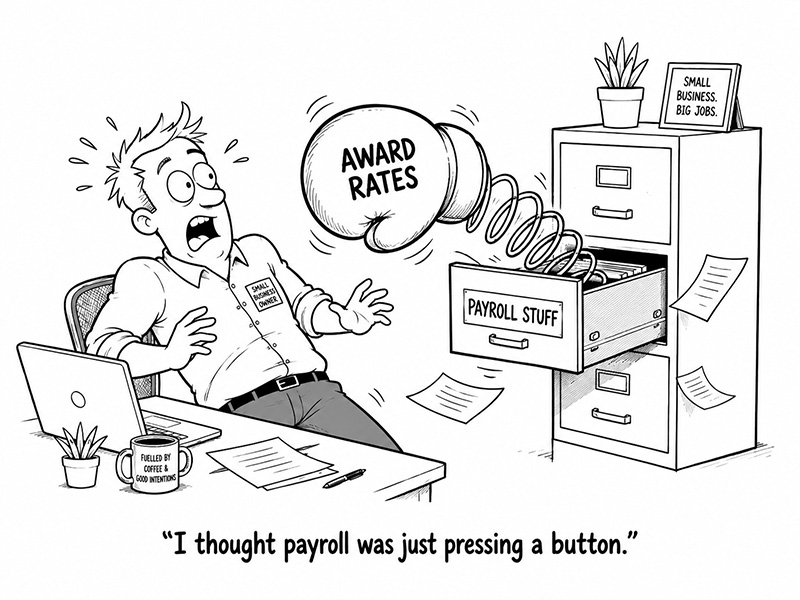
If you discover an underpayment, do not pop it in a drawer and hope it sorts itself out. Work out the underpayment period, check what the employee was paid against what they should have been paid, calculate the shortfall, speak with the employee and arrange back payment as soon as possible.
How you respond matters. A prompt investigation and back payment shows the business is taking the issue seriously. Ignoring it makes everything worse. Including, potentially, your legal position.
6. Get advice when you are unsure
Awards, classifications and wage rules can be confusing, particularly for small businesses without an internal HR or payroll team. If you are not sure which Award applies, whether an employee is classified correctly, or whether your payroll system is applying the right entitlements, get advice before the problem grows legs. Naturally, we will toot our own horn here. HR Staff n' Stuff helps businesses review Awards, classifications, employment documents and workplace compliance so they can stay on the right side of the law.
The short version
Criminal wage underpayment laws are now part of Australia's workplace landscape. The focus is on intentional underpayment, not honest mistakes, but employers still need to show they are taking reasonable steps to comply.
That means checking pay rates, understanding Awards, keeping proper records, training managers, and acting quickly when something goes wrong.
Getting pay right is not just about avoiding fines. It protects your business, your reputation and your people. Employees are entitled to be paid correctly for the work they do, and frankly, that should never be a controversial statement.
If you need help reviewing your Awards, checking classifications or working out your payroll obligations, get in touch with HR Staff n' Stuff. We would much rather work through a small payroll issue with you now than a much bigger one later.
FAQs
Yes, but only where it is intentional. Honest mistakes are not criminal, though employers may still have to back pay employees and could face civil penalties.
A payroll mistake is an error, applying the wrong rate by accident, missing an allowance, miscalculating overtime. Wage theft, in the criminal sense, requires intent: the employer knew an amount was owed and deliberately did not pay it. The factual underpayment can look identical in both cases; what separates them is what the employer knew and chose to do about it.
A small business can certainly be investigated. However, if it has fewer than 15 employees and the Fair Work Ombudsman is satisfied it has complied with the Voluntary Small Business Wage Compliance Code, the Ombudsman cannot refer that conduct for criminal prosecution.
Move quickly. Work out:
• How long the underpayment ran
• What the employee should have been paid
• What they actually received
• The shortfall (including any flow-on effects to superannuation and leave loading)
Then speak with the employee and arrange back payment. Document the steps you took, that record is what tells the story later if anyone asks.
Check Award coverage, review employee classifications, audit payroll regularly, keep accurate records, train managers, and get advice when something is unclear. The businesses that get into trouble are rarely the ones asking questions; they are the ones assuming everything is fine.