

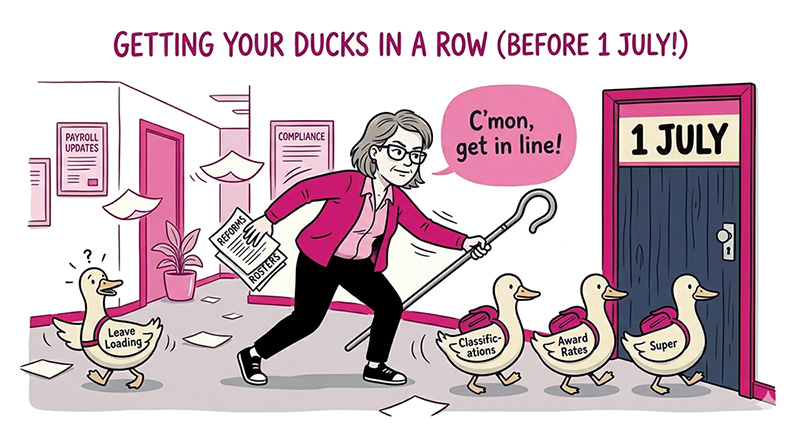
Well, it's that time of year again! Payroll reviews and pay increases time! Similar to last year, the Fair Work Commission has released its decision early in the month of June, providing all employers time to get their ducks in a row.
This follows on from our earlier overview of the workplace law changes coming on 1 July 2026. Here we dig into what the Fair Work Commission's decision means for your pay rates and super.
Award Rates
The Annual Wage Review 2026 decision from the Fair Work Commission is increasing minimum rates of pay from 1 July 2026.
- The National Minimum Wage will increase by 5.97% to:
- $26.44 per hour; and
- $1,004.90 per week based on a 38 hour full time working week.
- Minimum wage rates contained in modern awards will increase by 4.75%.
- The 2026–2027 High Income Threshold has not yet been released but we expect there to be an increase here as well. The current (2025–2026) high income threshold is $183,100 per annum.
Employers have a legal responsibility to ensure that all employees are paid at or above the applicable minimum rate prescribed by the relevant modern award, enterprise agreement or the National Minimum Wage.
If you already pay above award rates, you should be undertaking a payroll review to ensure that your employees current pay rate is at least the new minimum rate. If it falls under the new rate, you must increase their rate of pay to at least the new minimum rate of pay under the applicable Award. We encourage all employers to check all employees – those paid an hourly rate as well as those paid by way of an annual salary, to ensure all minimum award obligations are met.
If you pay your employees at the current Award rates, you need to apply the full 4.75% increase.
All revised pay rates must be applied to the first pay cycle from 1 July 2026.
A reminder that from 1 January 2025, the Fair Work Act introduced a criminal underpayment offence. Employers who intentionally fail to comply with minimum wage obligations may be exposed to significant penalties, including criminal prosecution in serious cases.
Award Classifications
The FWC has also made an important decision about the lowest-paid classifications in modern awards. After a multi-year review, it has decided to phase out the very lowest-paid classification for ongoing employment, called C13, and make the next wage level up, C12, the lowest wage rate for ongoing employment. (C14 is the current lowest classification but it is for induction period only, and will also be phased out).
This is important information for anyone with employees classified at a level C13, as over the next 3 years there will be an additional increase for the wages at this level, to close the gap between C13 and C12, eventually phasing out the C13 classification as the lowest classification for ongoing employment.
Additionally, the Commission has now completed the review of priority awards which it initiated in the 2024 Review decision. This will result in the phasing-in of wage increases to children's services employees, dental assistants, pathologists, disability home care workers, pharmacists and a range of other health professionals over the next few years. These increases will aim to close the gender pay gap, given that these occupations are female dominated and in the lowest pay groups. Stay tuned for movement here in the next few years.
Superannuation – Payday Super
The Superannuation Guarantee is remaining at 12% for employees, however, the big change is that superannuation is no longer to be remitted each quarter. This change, known as Payday Super, means that from 1st July, superannuation contributions must be received by the employee's superannuation fund within 7 business days of each payday.
If you need assistance undertaking a wage review alongside the new award rates, please don't hesitate to reach out to one of our team directly, or via here2help@hrstaffnstuff.com.au | 03 9590 0844.