

We often get asked by clients whether it’s worth undertaking a staff satisfaction survey. Our response is always the same…
It depends!
We absolutely advocate understanding how your staff feel about your business, their job, what’s working, and what’s not working. But before you jump into a survey, there are a few questions every employer should ask themselves.
Are you trying to understand general staff satisfaction with their job and the business or are you trying to understand how people feel about your workplace culture? Or are you trying to understand a bit about both?
And most importantly, are you actually prepared to review the responses, reflect on them, and take considered action?
Because here’s the thing… NO ONE and I mean NO ONE wants to take the time and the effort to complete a workplace survey, only for the results to never be shared, or for no actions to be taken. It’s like saying ‘I’d love to know what you think’ and then just not actually caring about what they think.
Employee surveys are not just a nice way to engage employees. They help identify blind spots, measure business health, and turn feedback into actionable changes that improve workplace culture and drive productivity.
Before You Run a Staff Survey, Be Honest About Why You’re Doing It
So! If the idea is to run a survey just to find out information, with no real intention to use the information to make changes, our advice is, don’t do a survey. Just have informal conversations with people and elicit feedback that way.
However, if you do really want to uncover what people think, and you genuinely are open to making changes and taking feedback on board – then definitely do it! Just keep in mind some of our pointers below.
Staff Satisfaction Survey vs Workplace Culture Survey
There are typically two types of general employee surveys (outside of specific targeted surveys such as safety awareness etc).
A thorough and robust staff satisfaction survey typically covers a range of key topics. This might include satisfaction about their training, opportunities, business leadership, communication, receiving feedback and coaching, understanding the organisation and their role within it and so forth. It’s really focused on what the business is providing to and for the employees.
A workplace culture survey is a little different and usually focuses on how employees feel about the input, environment and behaviour of other employees and leaders – rather than what the business provides them.
Both can be useful, but you need to be clear about what you are trying to learn before you start asking questions.
Anonymity Really Matters
If you make the decision to seek feedback from your employees via a survey it’s important to ensure anonymity and be clear about wanting to elicit all the feedback – the good, the bad and the ugly. Tell your people what you’re trying to understand and why, and that their honest feedback is critical to help shape decisions and actions in the future.
We also encourage our clients to advise upfront that they will be sharing the overall results with the whole business – it encourages people to participate.
Generally, employees will be wary of being blatantly honest in surveys for fear of backlash. They will also be naturally wary of the genuineness of anonymity. Survey Monkey for example, is generally a great tool but many employees know that IP addresses can be tracked, and individual responses can be uncovered, leading to a lack of honesty and forthrightness in responses.
It is usually helpful to engage a third party to execute your staff survey properly. Providing employees with piece of mind about anonymity and professionalism and engaging an external facilitator usually demonstrates to employees that there is a genuine desire from the business to understand the truth of how people feel and think about the business.
Conducting annual or bi-annual surveys is also highly recommended – and when you have a rhythm going and people start to trust the process and the anonymity, they end up opening up more and being more honest in subsequent surveys.
Be Clear About What You Want to Learn
Once you decide to conduct a survey, be clear about three things.
- What you want to learn
- That you will take on board the feedback and make changes / improvements where appropriate and
- What questions you will ask
What you want to learn
If there is a specific problem you are trying to solve, make sure you are clear on what that is before designing the survey.
There is no worse situation than spending time and money setting up a survey, asking employees to spend time and thought responding, and then discovering you didn’t actually learn what you needed to know.
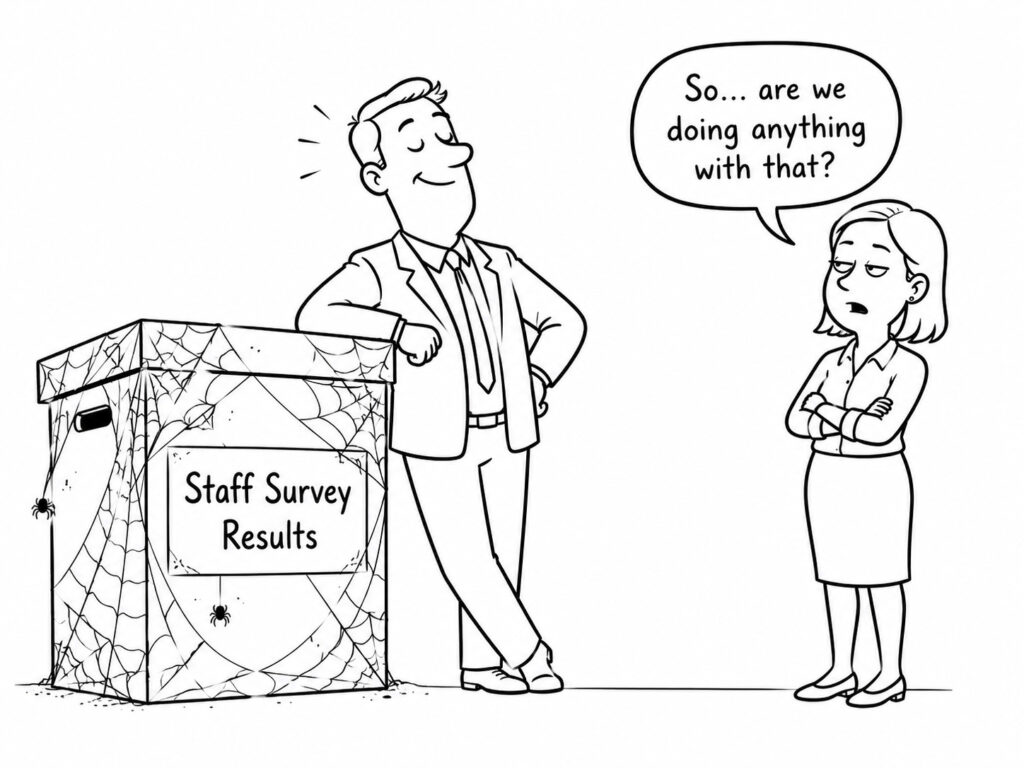
Use the Feedback Properly
Before even starting, be very clear (with yourself) that you are open to receiving the feedback and that you have the time and space to make some changes in line with any feedback you receive.
Don’t do one if the outcome is going to be "Thanks for your feedback. We're taking it on board but we're too busy to make any changes just now, and we will revisit in the future." Just don’t proceed now, if this is the case.
Carpark it until you can use the information wisely to make small changes where employees are dissatisfied.
Ask Good Questions
Once you understand what problem you are solving or what you want to learn, draft your questions.
Surveys are always better if you can collect data (not just subjective commentary), so design your questions to collect data – but also provide the opportunity for employees to leave comments as well.
The data gives you information you can act on. The comments assist you with understanding the data and may assist with what some of the solutions or changes may need to be.
Where Businesses Go Wrong
Over the years, there are two key lessons I have learned from working with clients and undertaking staff surveys.
The first is that frequent, regular surveys are often not helpful. (Well, in my opinion, and I’m right!) Frequent pulse surveys can frustrate employees because they are being asked for feedback before any real change has had time to take effect.
The second is that asking for feedback and then doing nothing is worse than not asking in the first place.
It completely disengages the team.
That includes failing to share the results, failing to listen, and failing to take any action.
What Makes a Staff Survey Successful?
The key to a successful business is having productive and engaged employees who want to do what needs to be done.
That means having people who feel appreciated, valued and heard, and who understand their role and how they contribute.
Surveys can be a great tool to help achieve this, but only if you:
- Ensure their anonymity
- Know what you want to learn
- Ask good questions (elicit data and comments)
- Share the results openly. Focus on what employees’ rate highest, and what they rate lowest… (share the good and the bad)
- Engage employees in solutions and actions from the survey. At the very least, share what you plan to do to make changes
- Do what you say you will do. Make small improvements. Find the low hanging fruit for some quick wins - surveys always reveal some! Then consider the big-ticket items.
Final Thought
A staff survey should never be the hero of the story.
It is simply the tool that helps point you towards what needs attention.
As David MacLeod OBE put it:
“Where employee engagement is transactional, the organisation sees the survey as ‘the hero’… Where it is transformational, the survey is merely the tool that directs us to areas in need of attention.”
If you would like to discuss whether a staff survey is something your business should be considering, reach out to our team for an initial discussion.
We will happily tell you whether it is the right tool for now based on what is happening in your business. If a survey is the right solution, we can help design and facilitate one that suits your needs. We also work with excellent third-party providers who offer thorough, benchmarked survey tools.
We look forward to talking with you soon.
Frequently Asked Questions on Staff Satisfaction Surveys
Staff satisfaction surveys are worth doing. If the business is genuinely prepared to review the results, share key findings and take action. If there is no intention to use the feedback, it is usually better not to run a survey.
Surveys should include questions about communication, leadership, training, role clarity, feedback, development opportunities, workload and how employees feel about the business overall.
A staff satisfaction survey usually focuses on how employees feel about their job and what the business provides. A workplace culture survey focuses more on behaviour, trust, communication, leadership and the overall working environment.
Yes, wherever possible. Employees are more likely to give honest feedback if they believe their responses are genuinely anonymous and there will be no backlash.
Employers should review the feedback, share overall results, identify key themes, take action where appropriate and communicate what changes will be made. Asking for feedback and then doing nothing can damage trust.