

Psychosocial safety at work has emerged as a critical focus area in modern workplaces, especially as businesses seek to ensure not just the physical wellbeing of their employees, but also their mental and social wellbeing.
This can be a challenging area for employers to manage because there are many moving parts involved. One powerful way to support psychosocial safety at work is through effective work design, which helps identify and manage psychosocial risks while creating a workplace that supports both productivity and wellbeing.
Understanding psychosocial safety at work
n a nutshell, psychosocial safety refers to the psychological and social conditions that influence an employee’s mental health and wellbeing at work.
It’s an area governed by Work Health and Safety (WHS) laws in Australia, which require employers to eliminate or minimise psychosocial risks wherever reasonably practicable.
Common psychosocial risks in the workplace include:
- high workloads
- low job control
- remote or isolated work
- long working hours
- lack of role clarity
- poor management of organisational change
- insufficient support
- low reward and recognition
- harassment
- fatigue
- poor organisational justice (procedural, informational and interpersonal fairness)
- hostile work environments including bullying, violence or incivility.
Left unchecked, these factors can lead to stress, burnout and reduced employee morale, all of which impact business performance. No one wins.
You may also wish to refer to guidance provided by Safe Work Australia regarding psychosocial hazards and employer obligations.
How good work design improves psychosocial safety at work
Work design is the process of organising tasks, roles and the work environment in a way that optimises health, safety and performance.
According to Safe Work Australia's model guidance on good work design, good work design considers the abilities and vulnerabilities of workers and aims to create an environment where employees can thrive.
In a well-designed workplace, psychosocial stressors are identified and managed proactively. The focus is not only on physical safety, but also on how roles, workloads and interactions are structured to support employees mentally and emotionally.
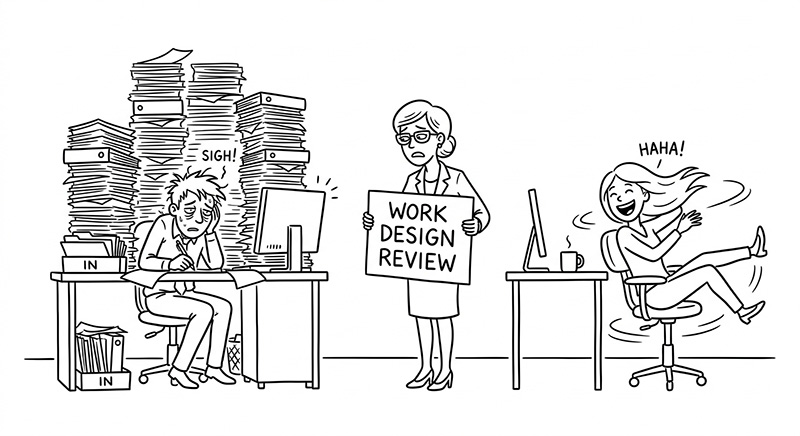
For example, you may have two engineers who originally shared equal responsibilities. Over time, one employee becomes overloaded while another has very little work.
At that point, you need to step back and rebalance responsibilities so the workload is spread more evenly.
How you restructure the work, communicate the changes, involve employees in the process and review the outcome afterwards all form part of good work design.
Key principles of good work design
At its heart, good work design is all about determining why, who, what, how, when and where work that is beneficial and necessary to your business success is being done.
It’s ensuring that the critical work is identified and made the focus, gaps in skill and capacity are addressed, communication is clear and employees are engaged and productive.
Good work design also recognises that employees have different abilities, experiences and vulnerabilities. Work needs to be designed with enough flexibility and support to reflect this.
Work design should be a dynamic process that evolves with the changing needs of the workforce. Regular assessments and feedback tools help employers identify emerging psychosocial risks and adjust work design accordingly and in a timely manner.
One size does not fit all
Different roles within your business may present very different psychosocial risks, so it’s important not to take a blanket approach.
Customer service and frontline roles
For example, customer service employees in an insurance business may spend all day dealing with angry, distressed or aggressive customers.
You may not be able to remove that exposure entirely, but you can reduce the risk through good work design by:
- recruiting people with strong resilience and conflict management skills
- clearly outlining these requirements in the position description as well as any other criteria needed such as demonstrated ability to handle aggressive or angry people, ability to remain calm in conflict and so on
- providing support mechanisms in place such as an EAP, access to counselling or regular breaks so your team can ‘walk it off’ and return to work with a clear head
- structuring rosters so employees can rotate between calls and administrative tasks.
Repetitive or isolated roles
Conversely, employees working in repetitive factory-based roles may experience low job control, minimal variety and isolation.
Again, there are practical ways to minimise psychosocial risks through good work design, including:
- recruiting people who genuinely enjoy repetitive work
- supporting employees with intellectual disability who may thrive in structured, repetitive environments
- cross-training employees to add variety
- involving employees in discussions about improving their role
- introducing automation or greater flexibility where possible.
Listening to employees about psychosocial risks
To improve psychosocial safety at work, you first need to understand the risks your employees are actually facing.
As a business leader, it’s unlikely you’ll have full visibility over every challenge your team experiences day to day, which is why consultation matters.
This may involve:
- employee surveys
- toolbox meetings
- team discussions
- one-on-one conversations
- speaking with health and safety representatives.
The goal is to identify psychosocial hazards early and determine practical ways to minimise or eliminate them.
Of course, there is a big difference between something that is a genuine psychosocial risk, and people just not enjoying specific tasks that they are required to perform as part of their role.
Make sure you fully understand if there is indeed a risk, or simply a dislike.
Good work design is good business
Investing in psychosocial safety through effective work design isn't just about compliance; it's also good for business.
A workplace where employees feel valued and supported is likely to experience lower turnover, stronger engagement, and better overall performance. Psychosocial safety reduces absenteeism and presenteeism (where employees are physically present but not mentally engaged), leading to more consistent productivity and a stronger bottom line.
Moreover, a reputation as a supportive and mentally healthy workplace can attract top talent, giving your business a competitive edge in the labour market. In an era where employees are increasingly prioritising work-life balance and wellbeing, businesses that prioritise psychosocial safety are more likely to attract and retain skilled workers.
As a business leader, you play a pivotal role in helping your business to create work environments that are not only physically safe but also psychologically and socially supportive. By focusing on effective work design, you can help eliminate psychosocial risks, foster a positive and healthy culture, and ultimately drive better business outcomes.
Psychosocial safety is more than a trendy buzzword. It is now a legal requirement for Australian businesses.
There is a lot to consider, so if you need practical HR support reviewing psychosocial risks, improving work design, or delivering Respect at Work training for your team, the HR Staff n’ Stuff team is always happy to help.
FAQs About Psychosocial Safety at Work
Psychosocial safety refers to workplace conditions that affect employees’ mental health, wellbeing and social functioning, including workload, support, bullying, fatigue and role clarity.
Yes. Australian WHS laws require employers to identify and manage psychosocial hazards in the workplace.
Common hazards include excessive workloads, poor management practices, bullying, harassment, low job control, fatigue and poor communication.
Employers can reduce risks through good work design, regular consultation, balanced workloads, clear communication, support systems and appropriate training.
Good work design helps employees feel supported, capable and engaged in their role, reducing stress and improving workplace wellbeing.