

This is episode 3 in a series, If you caught my last two blogs (Positive Duty Obligations and Leadership Consistency) this one builds directly on both. Psychosocial hazards in the workplace.
Many of you have likely heard this phrase and popped it in the too hard basket, which is understandable… However, as all employers now have obligations to reduce psychosocial hazards in the workplace, I thought it would be good to break it down for you.
What is a psychosocial hazard?
Well, in simple terms it is something in the workplace that could lead to a mental health injury. Most people understand immediately that bullying and harassment in the workplace is a psychosocial hazard, but there actually 14 key psychosocial hazards identified that could lead to a mental health injury that you may not have considered. These include:
- Poor Support – not providing employees with clear guidance, feedback or leadership. This can lead to isolation and increased stress.
- Poor Workplace Relationships – strained or hostile relationships including gossip, a blame culture, inconsistent feedback or leadership, can lead to psychological harm.
- Exposure to traumatic events or materials – exposure to distressing content can cause emotional exhaustion and long term harm if not managed properly
- Poor environmental conditions – noise, poor lighting, extreme temperatures, and inadequate privacy can create ongoing discomfort or fatigue
- Remote or Isolated work – limited access to supervision or team connection can leave workers unsure of expectations, alone and at higher risk of stress, errors and disengagement
- Violence and aggression – I’m sure I don’t need to expand on this, but just in case, any kind of verbal abuse, threats, intimidation or physical violence from clients, the public or coworkers can cause immediate and long lasting harm
- Low reward and recognition – when effort and contribution aren’t fairly acknowledged (and no, paying the wages is not enough!), workers may feel undervalued and disengaged.
- Poor change management – poorly managed change without consultation communication or support increases uncertainty, stress and erodes resilience.
- Poor organisation justice – perceived unfairness in decisions, processes or outcomes erodes trust. As per my last blog, inconsistent leadership can lead to these perceptions too. This can cause frustration and disengagement.
- Low job control – limited influence over how or when work is done can leave workers feeling powerless, stressed and bored.
- Poor role clarity – Unclear responsibilities, authority or expectations increases stress and uncertainty
- Unrealistic job demands – demands that exceed time, resources or capability, or are too low or inconsistent can cause fatigue, burnout, boredom or disengagement
As well of course, as bullying and harassment.
Why is this important?
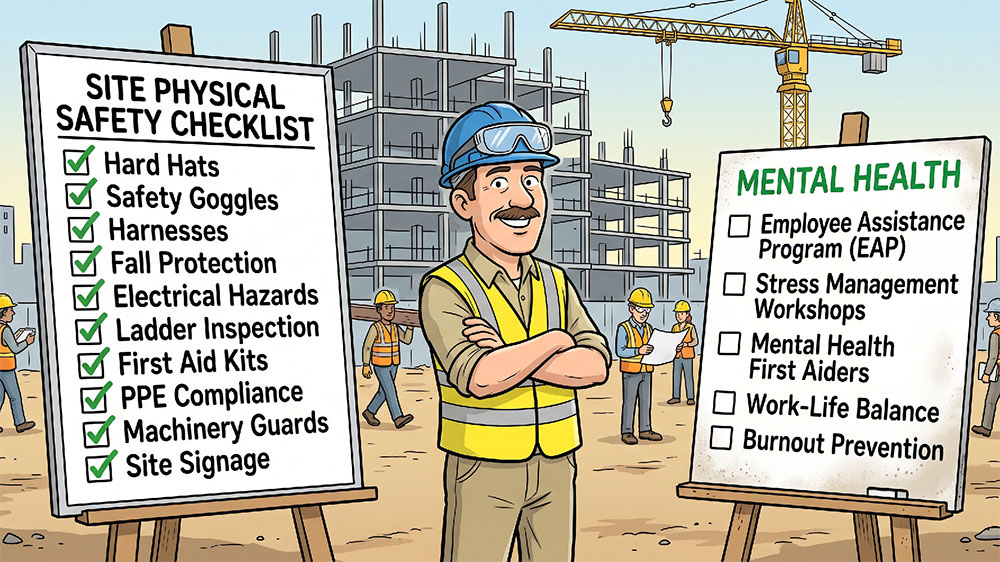
Well, employers now have the same obligation towards employees' mental health as they have to their physical health. Over the past 20 years or so, employers have really understood the need to keep workers physically safe, and now it’s a rare occasion that we find any of our clients failing in this area. From wearing appropriate PPE, to forklift training and management, use of ladders and scaffolding, and educating people on proper lifting techniques, we’ve come a really long way in keeping employees physically safe across the board.
That same effort and attention is now required for employee’s mental health.
So, How Do You Actually Do It?
I can hear you all saying "but how", and being frustrated that employees, mostly as adults, surely should have some responsibility for their own mental health. Well, yes, of course they do. But just like you removed the ability for someone to climb up on a roof without a harness or safety scaffolding to ensure their physical safety, you have to do the same to try and eliminate or reduce the psychosocial hazards that could cause one of your employees a mental health injury.
The list of 14 potential hazards I listed above could be overwhelming. You don’t have to try and tackle all of them at once. You can take several different approaches:
- Undertake a risk assessment on the 14 items to identify where some key risks may be, and work on them first.
- Ask your leadership team to weigh in on what they think could be improved to reduce or eliminate any of the risks
- Develop robust position descriptions – having good PD’s in place helps address several of the potential risks
- Ensure you have a great suite of policies in place – have good policies on bullying and harassment and an easy to access grievance procedure so employees can flag concerns around job demands and low job control.
- Develop your leaders – I know you probably think I’m a broken record, but seriously, if you educate and develop your leaders, many of these risks become very low risk for you.
WorkSafe Victoria have started focusing on workplace safety audits that focus on psychosocial hazards, rather than physical ones, as a way to get employers to focus in this area. Several of our clients have now had unannounced visits for this purpose. Along with this being a legal obligation for businesses, think about the long lasting harm you could do to an employee (inadvertently) by not assessing the risks in your business and working to reduce them. That’s an ethical ongoing commitment to your team's well being. I read recently where someone said ‘work should challenge us, but it shouldn’t break us’. That really resonated with me and is a really simple way of checking yourself. Are you breaking your people?
Creating a mentally healthy workplace starts with awareness, is followed by good intention, and ends with action. Start planning what you can do to take action and reach out to the HRSS team for help as needed! You know it – we’re always here to help.
FAQs
They include poor support, poor workplace relationships, exposure to traumatic material, poor environmental conditions, remote/isolated work, violence and aggression, low reward and recognition, poor change management, poor organisational justice, low job control, poor role clarity, unrealistic job demands, and bullying and harassment.
Yes. Employers have the same legal duty to manage psychosocial risks as they do physical safety risks under WHS law.
Yes, WorkSafe Victoria has been running unannounced audits specifically targeting psychosocial hazards.
A simple risk assessment across the 14 hazards, paired with solid policies and leadership development, covers most of the ground.