

It’s a question we get asked a lot. Usually when someone already feels unsure and doesn’t want to get it wrong. This is where employers often start wondering whether they can terminate an employee on sick leave and what the rules actually are.
Employees are entitled to take personal leave when they’re unwell or need to care for someone else, provided they meet the requirements under the Fair Work Act (such as giving notice and reasonable evidence if requested). Most of the time, they take a few days off, recover, and return to work as normal.
But sometimes things aren’t that straightforward…
You might find yourself needing to make a decision about an employee’s role while they’re still on sick leave and that’s when the question comes up:
Can you terminate someone while they’re on sick leave?
The short answer is yes.
But (and there’s always a but with HR)… it depends entirely on why you’re doing it and how you go about it.
When you can terminate an employee on sick leave
If the reason for the termination has nothing to do with the employee being unwell, you may be on solid ground.
A common example is redundancy.
Let’s say Jeffrey is on sick leave, and during that time the business decides to close or restructure due to financial pressures. A redundancy process begins across the team.
Even though Jeffrey is off work, he should still be included in consultation processes unless he’s too unwell or chooses not to participate. If the role genuinely no longer exists, consultation obligations have been met, and the redundancy is genuine, you can terminate his employment
In that situation, the decision isn’t about Jeffrey being sick, it’s about the role no longer being required.
When you can’t terminate an employee on sick leave
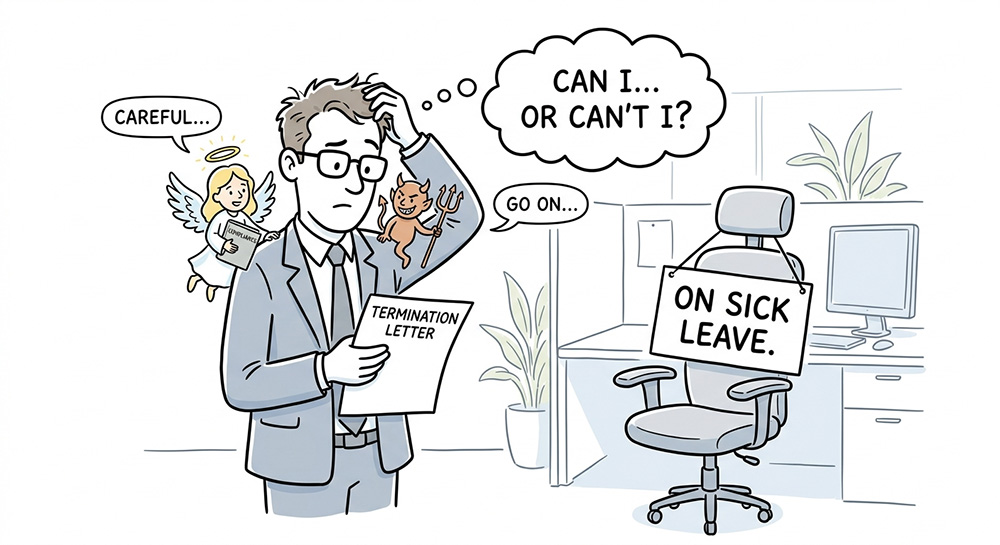
Now let’s flip that.
Jeffrey is on sick leave. The business is operating as usual. His role still exists and is waiting for him. He’s expected to return in a few weeks.
But the employer becomes frustrated with the absence and decides to terminate his employment so they can replace him.
That’s where things go very wrong.
Employees have a workplace right to take personal leave when they’re unwell. Taking adverse action against someone because they’ve exercised that right can expose you to a general protections claim, which shifts the burden of proof onto you as the employer. You would be required to prove that you did not terminate Jeffrey for an illegal reason – but you did, so you would lose the claim.
In short: you can’t terminate someone because they’re sick.
A quick note on sick leave entitlements
Under the National Employment Standards (NES):
- Full‑time employees are entitled to 10 days of paid personal (sick and carer’s) leave per year
- Part‑time employees receive a pro‑rata amount based on their hours
- Paid personal leave accumulates from year to year
Casual employees don’t receive paid sick leave. However, if a casual employee is not able to attend work due to illness, they can take unpaid sick leave.
For a broader overview, you can read our guide on employee leave entitlements in Australia.
So when does it become a grey area?
The risk profile tends to shift when you’re dealing with longer‑term absences.
If an employee has exhausted their paid sick leave and has then been absent on unpaid sick leave for more than three months (or more than three months within a 12‑month period), you can start considering whether they can perform the inherent requirements of their role.
At that point, it’s not about the absence itself, it’s about capacity.
But this is not something to rush.
You should:
- Request up‑to‑date medical information (where lawful)
- Understand the employee’s likely return‑to‑work timeframe
- Consider reasonable adjustments where appropriate
- Follow a fair, transparent, and documented process, usually involving a show cause process to better understand the issues and prognosis for return
This is where we often see employers move too quickly and that’s when things unravel into unfair dismissal or general protections claims.
The takeaway
You can terminate someone while they’re on sick leave.
But you can’t terminate them because they’re on sick leave.
It sounds like a small distinction, but legally it’s a big one.
If the reason for termination is valid, unrelated to the illness, and you’ve followed a fair and lawful process, you’re generally in a much safer position.
If not, it can become a very expensive mistake.
Don’t guess if you’re not sure.
These situations are rarely black and white, and a quick conversation upfront can save a lot of stress later.
If you’re dealing with a situation like this and you’re unsure what the right next step is, reach out to the HR Staff n’ Stuff team. We’ll talk it through with you and help you get it right.
Here are some of the most common questions we’re asked about sick leave and termination.
FAQs
Can you terminate an employee on sick leave in Australia?
Yes, an employee can be terminated while they’re on sick leave but only if the reason is lawful and unrelated to their illness. Terminating someone because they are unwell or taking personal leave can lead to serious legal consequences.
How long is an employee protected while on sick leave?
Employees are generally protected from dismissal while they’re legitimately using their paid sick leave and have provided reasonable evidence if requested. Protection can also apply during periods of unpaid leave, particularly if it is less than three months.
Can you dismiss an employee for being sick too often?
Not simply because they are using their sick leave. An employee has a workplace right to be unwell. However, if ongoing absences mean the employee can no longer perform the inherent requirements of the role, termination may be considered but only after a fair, evidence‑based process and after meeting the threshold of three months of unpaid sick leave once their paid leave has been exhausted.
What happens after 3 months of sick leave?
If an employee has exhausted their paid leave and has been on unpaid sick leave for more than three months (or more than three months within a 12‑month period), an employer may begin assessing their capacity to return to work. Any decisions must be based on medical evidence and a reasonable process.
Do casual employees get sick leave?
Casual employees do not receive paid sick leave. However, if a casual employee is unwell and able to attend a rostered shift they can take unpaid sick leave.
Do employees need to provide proof of illness?
Yes. Employers can request reasonable evidence, such as a medical certificate or statutory declaration, to support an absence due to illness or injury. Employers should have clear policies in place to advise employees when they are required to provide evidence.