

When you're leading a team, capacity should always be front of mind. Do you have the right headcount and the right skills to actually deliver for your clients? It sounds obvious, but if you're not watching work capacity, how would you know?
And here's the follow-up question I want you to sit with: how would you know if you need to grow or shrink your team if you don't actually know who's working hard and who's just hardly working?
So, hand on heart… do you know who on your team is genuinely productive, and who's just busy being busy?
Meet the Loud Labourer
I want to introduce you to a term you've probably encountered but never had a name for: the ‘loud labourer.’ It was coined by André Spicer, a Professor of Organisational Behaviour at Bayes Business School in London, and it describes someone who goes out of their way to make sure everyone knows how busy they are. The late nights. The overflowing inbox. The ‘I'll have to do this after dinner’ comments. All of it, on show, on repeat.
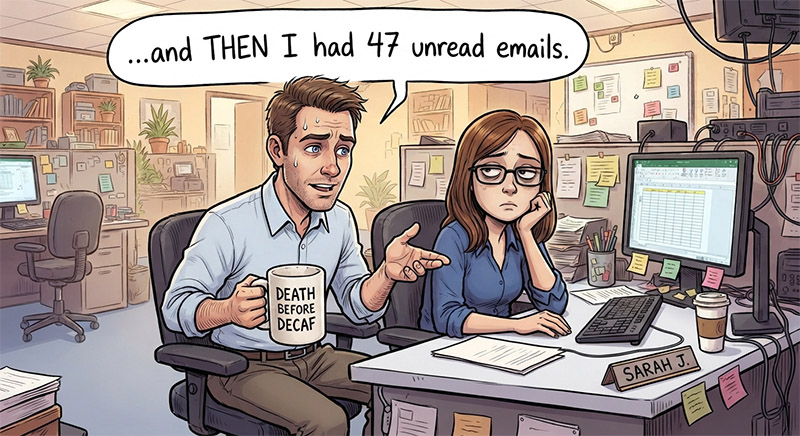
We've all worked with this person. They'll tell you exactly how many emails are sitting in their inbox and how late they had to work because of it. But here's the question worth asking: how much of that email traffic is actually driving value for the business? Is it project work, or is it just noise?
Now, to be fair, there's a real difference between someone having the occasional vent about a heavy workload, and someone who talks about it constantly like they've just returned from the front line of Inbox Wars. One is a normal, human moment. The other is performance.
And that performance isn't harmless. When one person makes a show of their busyness, it puts pressure on everyone else to do the same, regardless of what they're actually getting done. Before you know it, you've got a whole team competing to look busy instead of competing to get results.
Why Rewarding Busyness Backfires
Here's the thing leaders need to own: when we reward the appearance of busyness, whether through praise, promotions, or just extra attention, we're sending a very clear message. And it's the wrong one.
It tells your team that looking busy matters more than being productive. And that message causes real damage:
People stop working efficiently, because why would they, if dragging a task out gets noticed more than finishing it quickly?
Your genuinely high performers, the ones quietly doing excellent work without making noise about it, start to feel overlooked. And that's demoralising.
Trust erodes. When busyness gets rewarded over substance, colleagues start wondering whether each other's efforts are even real.
And ironically, innovation suffers too. People need mental space to think creatively, and there's none of that left when everyone's preoccupied with looking flat out.
It Starts With Leaders
Here's a truth I come back to again and again with clients: your team's culture is a direct reflection of what you reward. If you want a team that values real productivity over performative busyness, you have to build that on purpose. A few things that help:
Get specific about what ‘good’ actually looks like. Set goals tied to outcomes, not activity, and make sure they connect back to the actual goals of the business. And don't forget creative thinking counts as output too, even when it doesn't look ‘busy.’
Actually recognise the people doing the real work. Celebrate the wins that matter, whether that's landing a new client or finally closing out a deal you've been chasing for two years, and make sure people know their effort was seen.
Model it yourself. Your team is watching how you work, not just what you say about how they should work.
Protect work-life balance. Give people permission to switch off, and mean it.
Build trust and openness. Let people talk honestly about workload without fear of judgement.
A Few Practical Fixes
If you want to shift the culture from busy to productive, a few things genuinely help:
Protect deep work time. Some businesses set aside a block where no meetings can be booked, no one checks email, and calls go to voicemail. Just focused, uninterrupted time on the work that actually matters.
Invest in time management training. It's not one-size-fits-all, but the right approach can be a genuine lightbulb moment for someone who's drowning.
Use a proper project management tool. Something as simple as a Trello board can save you from a dozen ‘just checking in’ interruptions a day. We're big fans of Trello at HR Staff n' Stuff, and it's cut down on lost updates and unnecessary back-and-forth for our own team.
Ask yourself if it really needs to be a meeting. Could it be an email, a quick chat, or an update on a board instead?
Check in on workload distribution. Someone might be quietly drowning, and someone else might be sitting idle because a project wrapped up or a client moved on. Both are worth knowing about.
A thought to end on
I'll leave you with a line from John Wooden, one of the most successful basketball coaches in US history, and one that applies just as well to business as it does to sport:
“Don't mistake activity for achievement. To produce results, tasks must be well organised and properly executed; otherwise, it's no different from children running around the playground - everybody is doing something, but nothing is being done; lots of activity, no achievement.”
If you need support looking at your team structure, capacity, job descriptions, or ways to genuinely lift productivity, the HR Staff n' Stuff team is here to help.
FAQs
A loud labourer is someone who makes sure everyone knows how busy they are - long hours, overflowing inboxes, constant mentions of their workload, regardless of how productive they actually are.
André Spicer, a Professor of Organisational Behaviour at Bayes Business School in London, coined the term to describe employees who perform busyness rather than demonstrate real output.
Genuine overwhelm is occasional and honest... a real vent about a heavy patch. A loud labourer makes busyness a constant performance, regardless of actual workload or output.
It teaches your team that looking busy matters more than being productive, which discourages efficiency, demoralises your best performers, and erodes trust across the team.
Set goals around outcomes rather than activity, recognise genuine results rather than visible effort, and model healthy, focused work habits yourself.