On 19 October 2026, the Full Bench of the Fair Work Commission handed down a decision on a change to the Clerks Award which affects all employers across Australia who have employees governed by the Clerks – Private Sector Award 2020. This Award covers many administrative, clerical and office-based workers across the country in the private sector. The change was effective Monday 26th October 2026.
What Has Changed in the Clerks Award?
The change to the award now allows for all workers (governed by this Award) to make a request to work from home. Prior to this, only some people had the right to request flexible working arrangements, including parents of school-aged children or younger, people with a disability and people 55 years or older. A request for flexible working didn’t automatically include the ability to work from home either.
The updated Award provisions now provide the opportunity for anyone governed by this award to make a request to work from home regardless of their personal circumstances or eligibility to request flexible working. If they are covered by this Award, they can request to work from home.
How Does a Work From Home Request Work?
Employees must make their request in writing and clearly state which days, or how often, they want to work from home. Working from home can mean performing duties from the employee’s home, or another location.
The request does not create an automatic right to work from home. If the employer does agree, then they must put the arrangement in writing.
Can You Say No?
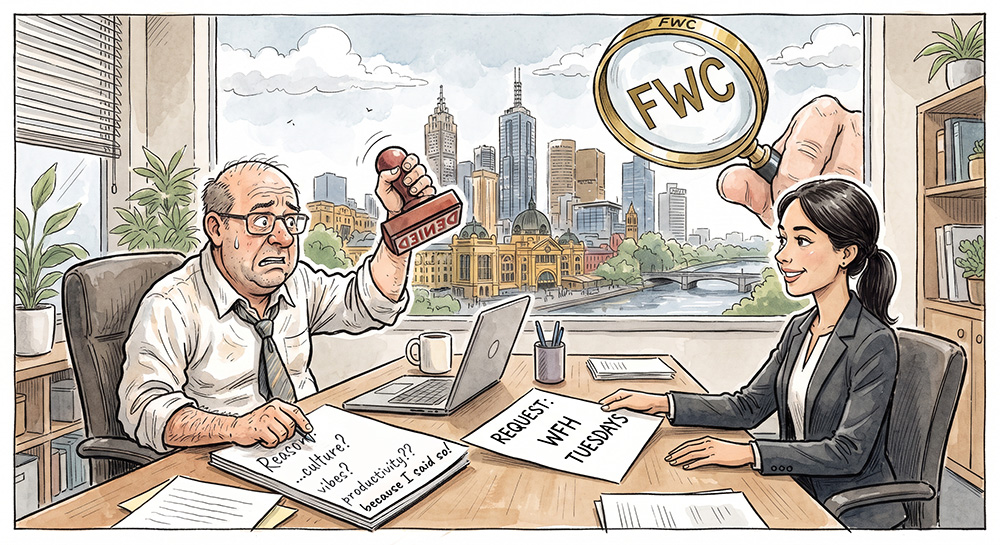
The employer does not have to agree to the request, however, any decision to not agree to the request must clearly state the reasons why (in writing), and the employer should attempt to consult with the employee or propose an alternate solution. Stating in a rejection letter that the request ‘does not meet the needs of the business’ is not going to be enough. The business needs to outline why it won’t work – additional costs incurred, because the role has a customer-facing component, specific tasks that need to be performed onsite and so on.
What Happens If There Is a Dispute?
If the employee wishes to, they can raise the matter with the Fair Work Commission to deal with the dispute. We have seen many cases lately where the Commission has overruled an employer's decision and permitted the employee to work from home, and this has occurred in cases where the employer has not been able to clearly articulate the specific reasons as to why the work from home request cannot be accommodated.
It is my opinion that the FWC has far too much power in making decisions that affect employers and the way they wish to run their businesses, but sadly, I am not in charge of the world and so it is that the FWC can overrule your preferences.
The lesson here is if you’re going to reject a request, make sure you’re very clear on the reasons for the rejection, and the negative impact it will have on your business. Simply stating that ‘no-one else gets to work from home’ or ‘as a business owner my preference is to have everyone in the office to create a good culture’ is not going to fly!
A Protected Workplace Right
Importantly, an employee has a protected workplace right to make this request. This means that employees are able to make the request without worrying about being treated unfairly, disadvantaged or facing negative consequences for making such a request. I’m sure you’ve heard the term ‘general protections’ and / or ‘adverse action’. If an employee starts being treated differently or adversely, because they made such a request, they can raise this with the Fair Work Commission as well. It’s a minefield!
What Should Employers Do Now?
Get ready for requests to work from home to start trickling in. If you’re not sure how to respond, or if you need any help or advice, don’t hesitate to call one of our team, because we’re always here to help.
And if you want to reference the relevant clause in the Award itself, you can find it in clause 5A of the Award
FAQs about the new Clerks Award work from home clause
Clause 5A of the Clerks - Private Sector Award 2020 lets any employee covered by the Award make a written request to work from home. It started on 26 October 2026.
No. The clause creates a right to request, not a right to work from home. If you do agree, the arrangement must be put in writing.
The request must be in writing and state which days, or how often, they want to work from home.
Yes. Give clear, specific reasons in writing, and try to consult with the employee or propose an alternative. Vague reasons like “it doesn’t meet the needs of the business” won’t be enough if the matter ends up in a dispute.
No. Making a request is a protected workplace right, so any adverse treatment could lead to a general protections claim.