
We often get asked by clients if they can ‘trial’ a new employee before confirming their employment. We're also approached by clients wanting to put on an unpaid intern. It's usually framed that it will be an outstanding opportunity for the potential intern to gather real life work experience. We have a bit to say on these subjects!
Unpaid Work Trials
In Australia, it’s really important to remember that you can’t ask someone to work for free. Even if someone offers, once they’re performing actual work, you must pay them at least the minimum rate under the relevant award or agreement. There aren’t any loopholes here. Things like “I’ll give you a trial and pay you $20 an hour cash” aren’t fair, and they’re not legal.
What Counts as a “Trial”?
That said, as part of a normal recruitment process, you can ask a candidate to complete certain tasks so you can get a sense of their skills and how they’d handle the role. This might be a short capability assessment or a few hours on the floor doing basic tasks so both sides can see whether the job is a good fit. The key is to keep it reasonable. Generally no more than a half‑day in most situations. Keep the candidate supervised for the entire trial.
The Built-In Trial Period
It’s also worth keeping in mind that the Fair Work Act gives employers a built‑in period to properly assess someone’s suitability once they’re hired. For businesses with 15 or more employees, that period is 6 months. For smaller businesses, it’s 12 months. This is called the Minimum Employment Term, and it effectively works like a probation period. During this time, an employer can end employment if the person isn’t suitable for the role, without needing to go through a formal performance management process.
Of course, this doesn’t give employers free rein. The usual rules still apply. You must have a lawful reason to terminate employment. You can’t dismiss someone for exercising a workplace right (like taking sick leave or raising a concern), and you can’t dismiss someone for discriminatory reasons such as age, religion, nationality, or similar protected attributes.
In short, if someone does any type of productive work for you, they must get paid.
Unpaid Internships
It’s also worth touching on unpaid internships, because the rules in Australia are quite specific. You generally can’t bring someone into your business as an “unpaid intern” unless the arrangement fits within very clear parameters. Our strong recommendation is to only use unpaid internships when they’re part of a formal school or university work‑experience program, where everything is structured and properly overseen.
Sometimes, though, people want to bring an intern on outside of a regulated program. In those cases, the Fair Work rules are very clear:
- the person must not be doing productive work
- the main benefit of the arrangement must flow to the intern, not the business
- the intern must receive a genuine learning experience, with real training or skill development
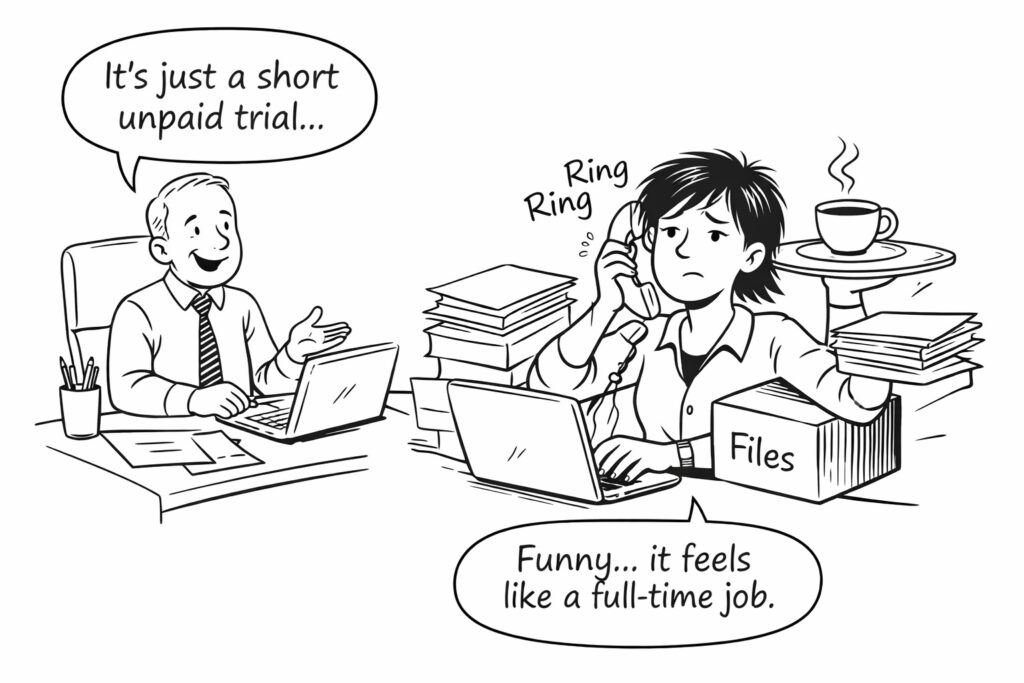
If the business is the one benefiting from the work being done, then the person is considered an employee and must be paid. A simple way to think about it is this: if the intern didn’t do the task and you’d need to pay an employee to do it instead, then it’s not an internship — it’s employment. And if the work is something the business actually needs done, it’s very likely an employment relationship.
A genuine internship looks quite different. The intern is the main beneficiary, they’re mostly observing, learning, and trying out tasks under supervision, and they’re not responsible for essential work. These arrangements are usually short‑term. The longer an “internship” goes on, the more likely it is to cross the line into paid employment.
Summary
In the end, whether you’re considering trial shifts or internships, the key theme is the same: fairness, clarity, and compliance with the law. Australia’s workplace rules protect both employers and workers. When you understand the boundaries, it becomes much easier to create arrangements that are respectful, transparent, and genuinely beneficial for everyone involved.
Short, well‑structured capability assessments can absolutely help you find the right person for the job. As long as they’re reasonable and not a substitute for paid work. And internships can be a great learning opportunity when you set them up properly. The intern should be clearly gaining skills and experience rather than filling a productive role in the business.
By keeping these principles front of mind, you can recruit confidently, support people fairly, and build a workplace culture that reflects integrity and good practice. Candidates and interns may well become some of your best and most talented recruits, so it’s worth putting your best foot forward to start the relationship off the right way!
Get in touch if you need any help with capability assessments, internships or any employment related matter! We’re always here to help.
❓ FAQs
Are unpaid work trials legal in Australia?
Only if they are short, supervised, and purely for assessing skills. If the work benefits the business, it must be paid.
How long can a trial shift be?
Typically no more than a few hours or half a day. Anything longer risks being considered unpaid work.
Can interns work unpaid in Australia?
Only in very limited circumstances, usually as part of a formal education program with genuine learning.
What is the minimum employment period?
6 months for larger businesses and 12 months for small businesses, allowing employers to assess suitability.