
Quiet quitting is one of those phrases that’s been doing the rounds for a while now. And most of the time, what people are really talking about isn’t quitting at all. It’s gradual disengagement.
No one’s resigned.
No policies have been breached.
The work is still getting done.
On the surface, everything looks fine.
But if you’re leading people, you can usually sense when something’s shifted.
The team member who used to speak up in meetings now stays quiet. They stop putting their hand up for projects. Emails become short, factual and transactional. The energy they once brought just isn’t there anymore.
We’re seeing gradual disengagement occur more frequently across Australian workplaces, particularly with hybrid work, skills shortages, ongoing burnout and the current cost-of-living pressures all in the mix.
So let’s talk about it properly.
What Quiet Quitting Really Is
When clients talk to us about quiet quitting, they’re usually not describing someone setting healthy boundaries, refusing unpaid overtime, or pushing back on unreasonable workloads.
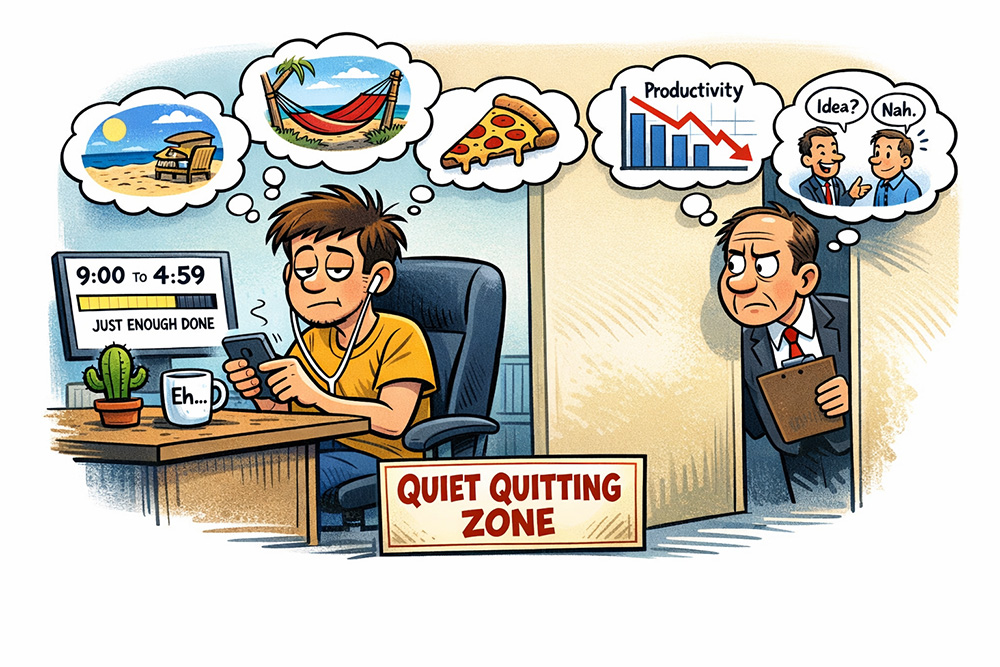
What they’re noticing is a pullback of discretionary effort. The extra energy someone used to happily bring to their role, but no longer does.
It often shows up as:
- Fewer ideas being shared
- Not volunteering for new or stretch projects
- Email communications are short and functional
- Silence in meetings where they used to contribute with enthusiasm
- Doing what’s required, but nothing more
- A general sense of emotional detachment from the team
It’s also important to be clear about what quiet quitting isn’t.
- Underperformance (where clear performance expectations aren’t being met)
- Active disengagement (where negativity or cynicism begins to spread)
- Toxic behaviour - conduct or behaviours that undermine the culture of the business
Quiet quitting sits in an awkward middle space.
Officially, nothing is “wrong”. It is technically acceptable. But when it occurs in someone who is previously an active and engaged team member, as a leader, you know something isn’t right either.
Why Employee Disengagement Is Becoming More Common
Common drivers in today’s workplace include:
- Teams stretched thin due to skills shortages
- Hybrid work reducing informal connection
- Lingering burnout that hasn’t fully resolved
- Cost-of-living pressures affecting wellbeing
- Employees reassessing what they want from work
In our experience, disengagement is rarely the core problem.
It’s usually a symptom of something else sitting underneath.
That’s why the most effective leaders approach these situations with curiosity first, rather than accusation.
Remember, everyone has the odd off week. That’s normal. But when those changes stick around, that’s usually a signal that leadership needs to lean in, not pull away.
Hybrid Work Makes Quiet Quitting Harder to Spot
In hybrid workplaces, disengagement can hide behind a screen.
One client assumed a remote worker had lost motivation. They were quieter in meetings and appeared to be doing the bare minimum. This was completely out of character for them.
The real issue was that they felt invisible next to office-based colleagues.
Once expectations were clarified and structured check-ins were introduced, engagement improved significantly.
While hybrid work arrangements come with significant benefits, it does require more deliberate connection with team members.
A Real Example: The Promotion That Didn’t Happen
A high performer applies for an internal promotion.
They don’t get it.
In one client’s case, the decision itself was reasonable but the way it was communicated wasn’t. The process was handled poorly by a manager who needed some additional training (but that’s a story for another blog!).
Almost straight away:
- They stopped volunteering for projects
- Their input in strategy discussions dropped off
- Their enthusiasm for the business noticeably faded
Their output was still acceptable, but their engagement and commitment levels had shifted and everyone could feel it.
What fixed it wasn’t a hard-nosed “buckle up” discussion or a formal process. It was a genuine, proper conversation to understand how they were feeling.
Their manager acknowledged the disappointment, owned the communication gaps and clearly mapped out what skills they needed to develop and increase their potential for the success when applying for the next opportunity. Together, they put a realistic development plan in place.
Engagement didn’t bounce back overnight but it did return. And when the next promotion opportunity came up? They absolutely nailed it.
Prevention Is Always Easier Than Repair
This is why we often talk to clients about proactive leadership. Addressing disengagement early is almost always easier (and safer) than trying to fix it once it’s entrenched.
1. Clarity Beats Assumption...Every Time
Ambiguity is a breeding ground for disengagement. It’s confusing and frustrating for employees when they don’t have clarity around job expectations.
Employees need to know:
- What good performance actually looks like
- How their performance is measured
- What discretionary effort means in their role
- What progression realistically requires
From an HR perspective, this isn’t just good leadership, it’s also critical if performance management ever becomes necessary.
In disputes, the Fair Work Ombudsman will always look at whether expectations were clear and communicated effectively. If they weren’t, things can get messy fast.
2. Psychological Safety Really Does Matter
When people don’t feel safe to speak up, they withdraw quietly.
Leaders should ask themselves:
- Are people empowered to challenge ideas respectfully?
- Are mistakes treated as learning opportunities?
- Do managers genuinely listen?
- Are legitimate concerns acted on, not ignored?
Psychological safety isn’t about avoiding accountability. It’s about allowing issues to surface early, instead of allowing them to fester.
3. Be Honest About Burnout
Workforce shortages and rising pressure mean many employees are operating at full capacity.
When people are overloaded, discretionary effort is usually the first thing to disappear.
Leaders may not always be able to reduce workload immediately, but they can work with individuals to:
- Reprioritise what needs to be done now and what can wait?
- Pause non-essential projects
- Acknowledge pressure openly
- Be transparent about commercial realities
Sometimes, simply feeling heard makes a bigger difference than people expect.
When Disengagement Becomes a Performance Issue
If disengagement continues, the conversation needs to shift from supportive to clear. It’s not always easy to know what to say but a simple starting point might sound like:
“I’ve noticed some changes recently and I wanted to check in. I value your contribution and want to understand what’s happening.”
ALWAYS listen first. The issue may have nothing to do with work, they may have caring responsibilities, family illness or any number of personal battles they are trying to juggle.
Sometimes, despite conversations and support, disengagement persists. If behaviour impacts performance, quality, deadlines or team morale, a more structured approach may be required, such as a performance improvement process.
Handled properly, this can be fair and effective. Handled poorly, it exposes the business to serious risk.
A fair process should include:
- Clear written expectations
- Measurable goals
- Defined review timeframes
- Regular check-ins
- Appropriate support (training, mentoring, EAP)
Employees need to clearly understand:
- What the issues are
- What improvement looks like
- What support is being offered
- What may happen if improvement doesn’t occur
And Sometimes It Still Doesn’t Improve
Not every situation can be turned around.
Sometimes the role just isn’t the right fit anymore. Maybe the motivation is genuinely gone, or sometimes people are already preparing to move on.
After a fair process, separation may be the right outcome for everyone involved.
Avoiding that decision for too long can frustrate high performers, lower standards and increase risk.
Leadership Is a Balancing Act
This is where leadership maturity really shows. Lean too far into compassion and standards slip. Lean too far into control and people stop speaking up, psychological safety collapses.
Strong leaders balance:
- Accountability to the business
- Fairness to the employee
- Responsibility to the wider team
Ignoring disengagement rarely makes it go away.
Final Questions for Leaders
If you’re noticing signs of disengagement, it’s worth asking yourself:
- Have I been clear about expectations?
- Have I been consistent?
- Have I really listened?
- Have I documented conversations appropriately?
- Am I avoiding a difficult discussion?
- What message does inaction send to others?
Quiet quitting is rarely about laziness. More often, it’s a signal of burnout, misalignment, unclear expectations or maybe it’s time for a change.
Handled early and thoughtfully, many of these situations can be turned around.
And if you’re unsure how to navigate disengagement with someone in your team, or how to identify whether a situation should stay informal or move into performance management, the HR Staff n’ Stuff team is here to help.
We’ll help you support your people, protect your business and get things back on track.
✅ FAQs
What is quiet quitting, really?
It can be, particularly when it involves previously engaged employees pulling back over time. It’s often a sign something’s changed, not a sign someone is lazy or difficult.
Should I address disengagement straight away?
Yes, but informally first. Early, honest conversations are far more effective than letting disengagement drift until it becomes a performance issue.
Does quiet quitting automatically mean performance management?
No. Most situations start, and sometimes end, with clarification, support and better communication. Formal performance management is only needed if disengagement begins to affect output, quality or the wider team.
Can quiet quitting be turned around?
Often, yes. When expectations are clear, feedback improves and people feel heard, engagement can return. Not every situation is fixable, but many are if addressed early.
Does hybrid work make disengagement harder to manage?
It can. Reduced visibility means leaders need to be more intentional with check‑ins, expectations and feedback for remote team members.
When should we get HR involved?
If you’re uncertain whether a situation should stay informal or move into performance management, getting advice early can protect both your people and your business.