

Let’s be honest. At some point, every business has experienced incompetence in the workplace in some form.
The person who keeps missing deadlines.
The colleague who always needs “just a bit more help.”
The team member who never quite understands what’s required, even after it’s been explained three times.
It’s uncomfortable to talk about, but incompetence in the workplace is a real issue. And if it’s not handled properly, it quietly chips away at productivity, morale and trust.
What Do We Mean by Incompetence in the Workplace?
In simple terms, incompetence is when someone can’t perform their job to the required standard.
That might show up as:
- Ongoing errors
- Missed deadlines
- Poor-quality work
- Over-reliance on others
- Repeated “I didn’t know” or “I wasn’t shown that”
Sometimes it’s genuine. The person may lack training, experience or confidence. Often, it comes down to the classic skill versus willingness question.
If it’s a skill issue, more training is required.
If the person has demonstrated the skill previously but is not applying it, it may indicate a willingness issue. (which opens another whole conversation!).
There is also a third variation.
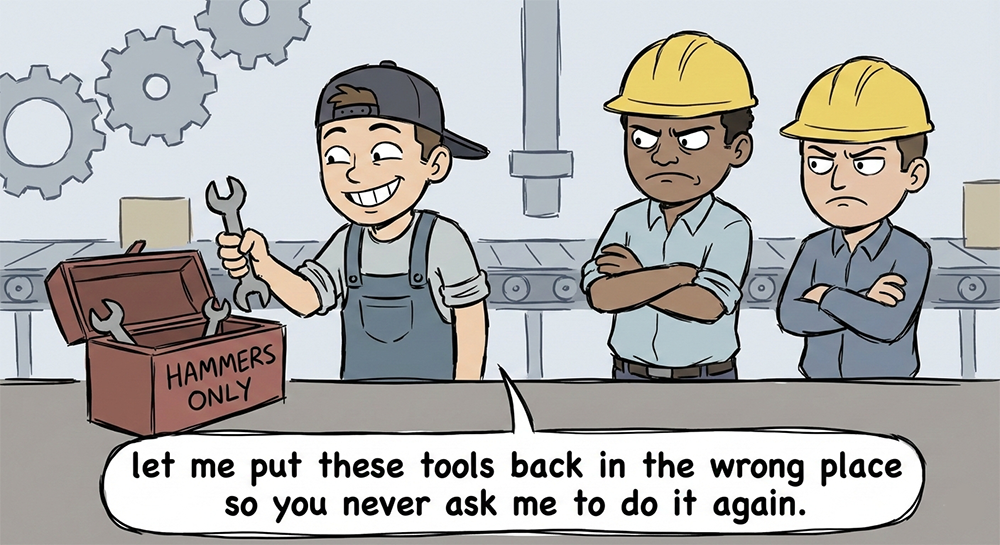
Sometimes, it’s what’s often called “weaponised incompetence” (also known as strategic or malicious incompetence). That’s when someone acts incapable to avoid tasks, dodge responsibility, or shift work onto others. (So, a willingness issue, but it shows up in a different way).
And yes, it happens more often than you might think…
Genuine Skill Gaps vs Weaponised Incompetence
It’s critical not to jump to conclusions.
Sometimes the issue is a genuine skill gap
- They were never properly trained
- The role has evolved but they haven’t
- They are overwhelmed or under-resourced
- They are hesitant to admit they are struggling
Other times, the pattern looks different
- They repeatedly “don’t know how” to complete tasks others manage
- They wait until the last minute to say they’re stuck
- They rely heavily on colleagues to rescue them
- Once someone else takes over, they disengage
The difference matters because your response should be different.
How Incompetence in the Workplace Spreads
Unchecked incompetence doesn’t just affect one person’s output.
It leads to:
- Frustrated high performers who feel they’re carrying the load
- Increased stress across the team
- Declining standards (“Why bother, no one else does?”)
- Resentment toward leadership
- Eventually, staff turnover (which comes at a significant cost)
Here’s the kicker: if leaders repeatedly “step in and fix it,” they can unintentionally reinforce the problem.
Over-functioning managers create under-functioning employees.
It ends up being a case of what gets rewarded, gets repeated. ‘My manager stepped in last time and did it (I like that), so I’ll do it again (or not do it, as the case may be) and once more he or she will step in.’
What Leaders Should Do
1. Identify the Cause
Before you label someone as incompetent, get curious. Is this a training issue? A clarity issue? A pattern of laziness or avoidance? An issue between two employees?
Have a calm, direct conversation. Ask questions. Listen. Observe.
2. Set Clear Expectations
Vagueness is the enemy of accountability.
Be specific about:
- Deadlines
- Standards
- Ownership of tasks
- Employee's position description requirements
Where necessary, ask the employee to demonstrate their capability in completing a task.
3. Provide Support
If there is a genuine capability gap, offer training or coaching to support their improvement. Break tasks into clear steps and check in regularly to see how they are progressing.
Most people don’t want to underperform. With the right support, engaged employees will appreciate the help and start to improve.
4. Establish Accountability
This is where many leaders wobble, mostly because they’re either scared of confrontation or worried they’ll misstep and end up with some sort of Fair Work matter.
But you have to set those fears aside and take appropriate action.
If someone repeatedly drops the ball, don’t reward poor performance by taking the task off them or redo their work yourself. If you continually ‘rescue’ them, they won’t learn or improve. In many cases leaders just get frustrated and ‘do it themselves’ but that’s not the right approach. If you do that, you may as well consider that you will have to do it forever.
Instead:
- Set firm deadlines.
- Follow up consistently.
- Let natural consequences occur where appropriate.
Clear boundaries are not unkind. In the words of Brené Brown "To be clear is to be kind".
Managing Weaponised Incompetence
If you suspect the behaviour is strategic rather than accidental, remember that the more you fix, the more they’ll lean back.
Document Everything
Keep records of:
- Missed deadlines
- Repeated errors
- Coaching provided
- Training offered
- Follow-up conversations
This protects both you and the business and can assist with formulating a Performance Improvement Plan (PIP) if and when it’s time to implement one.
When It Becomes a Performance Issue
If incompetence persists despite providing clear expectations, support and/or feedback, it becomes a formal performance management matter.
In extreme cases, ongoing inability (or refusal) to perform the inherent requirements of a role can lead to termination. That’s never the first step, but it may be the final one if the behaviour is disrupting operations or harming the team.
The best way to move forward initially is to implement a Performance Improvement Plan that
- clearly steps out the areas of concern (where expectations are not being met)
- Specify the required improvement
- Provide a ‘fair and reasonable’ time frame for improvement.
We always recommend implementing a PIP with the intent to improve the performance or behaviour. However, if the person can’t ‘right the ship’ then you have also laid a solid foundation to exit the employee if required.
The Leadership Reality
Dealing with incompetence in the workplace is uncomfortable.
It requires:
- Honest conversations
- Sitting with discomfort
- Setting boundaries
- Tackling matters head on instead of letting them go and hoping they’ll improve on their own
Hope is not a strategy.
Most people rise when expectations are clear and support is fair. And when they don’t, good leadership means addressing it, not ignoring it or working around it.
Strong teams are built on accountability, not avoidance. Nothing drains a workplace faster than everyone knowing there is a problem and watching it go unchecked.
If you would like assistance navigating any type of employee issue, don’t hesitate to reach out, because we’re always here to help 😊