

Managing people comes with plenty of moving parts, and leave entitlements are one of the big ones. We regularly receive questions about employee leave entitlements, so here’s your clear, practical reference guide.
Understanding what your employees are entitled to, and how those entitlements work in practice, helps you stay compliant, support your team, and avoid costly headaches.
Personal Leave (Sick & Carer’s Leave)
Personal leave is one of the most commonly used entitlements, so accuracy matters.
What Employees Receive:
- 10 days paid per year for full-time employees
- Pro rata for part-time employees
- Casual employees are entitled to unpaid personal leave if they are ill or injured
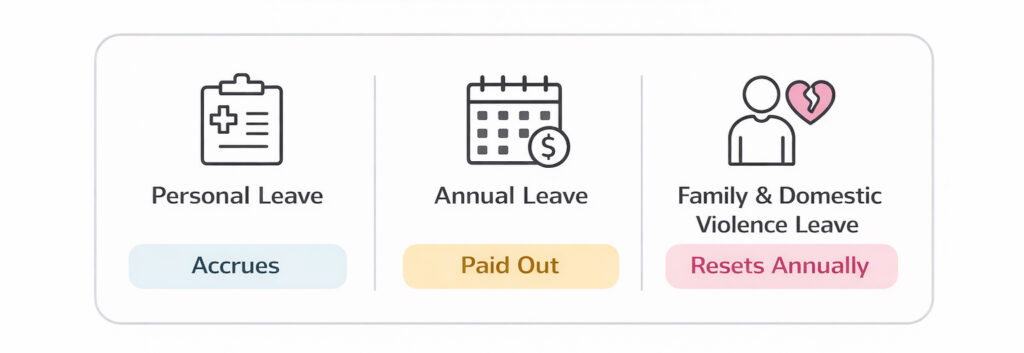
- Accrues year to year
- Paid at the employee’s base rate of pay
Employees can use this leave when they’re unwell or when they need to care for an immediate family or household member. It is not paid out at the termination of employment.
In practice, it cannot be used to ‘attend to personal matters’ or because they ‘need a day off’. Employees may only use personal leave when they are ill or injured and are unable to attend work, or for the employee to care for an immediate family or household member because they are ill or injured and need onsite care. It cannot be used for childcare needs – unless the child is sick or injured.
Employers can request a medical certificate as evidence of the illness or injury and the medical certificate must satisfy a reasonable person of its validity. We often write policies for our clients on use of personal leave where we include a rule that the client will not accept an automated certificate from an online platform – the employee must have had an in-person or telehealth consultation with an actual practitioner for a certificate to be valid.
Navigating personal leave can be tricky. Employees have a workplace right to be unwell. However some employees take excessive personal leave creating headaches for employers.
There are strategies you can employ to manage the use of personal leave effectively if it becomes a problem. Reach out to us for customised advice based on your specific situation.
If personal leave has been exhausted, an employee may request to use accrued annual leave or long service leave instead. An employer should not automatically apply these leaves without a request, or agreement to do so, from the employee.
Annual Leave
Annual leave supports employee wellbeing and productivity.
Entitlement:
- 20 paid days per year for full-time employees
- Pro rata for part-time employees
- Accrues progressively
- Unused leave is paid out on termination
- Paid at base rate (some awards include leave loading)
As an employer, you can manage when leave is taken but you must not unreasonably refuse a request. We recommend having an annual leave policy in place that clearly steps out any blackout periods (where you will not approve a period of leave), any notice periods required, any company shutdown periods where employees are required to use some of their annual leave, and importantly, that the business will not be responsible (financially or otherwise) if an employee makes travel plans prior to a period of leave being approved.
You can only direct an employee to take a period of annual leave (unless they agree) in line with the provisions to do so under the relevant Award or Fair Work Act. This usually means that you can only do so if they have for example, 8 weeks of accrued leave, and you must provide a period of notice for them to take the leave. We often get asked if the business can ‘make some of the team take some annual leave next week, because we don’t have any work on’. This is not allowed under the Fair Work Act and/or the Awards.
Employees can now request to have part of their accrued annual leave ‘paid out’. Employers can also suggest paying out of some employee leave. It can only occur by mutual agreement and under certain circumstances, The Fair Work Act sets out the rules around when you and can’t do this… or speak to one of our team for assistance…
Family and Domestic Violence Leave (F&DV)
This leave is designed to support employees experiencing family or domestic violence.
Entitlement:
- 10 days per year, available to all employees (including casuals)
- Does not accrue; it resets annually
- Paid at the employee’s full rate of pay for the hours they would have worked
Confidentiality is critical. Employers must handle these requests sensitively and securely and it is a legal requirement that F&DV Leave is listed on payslips as normal hours worked.
You have the right to request evidence of the need (and eligibility) for the leave, but please do so with sensitivity. F&DV Leave can only be used for certain things – it’s not a free for all. Events such as attending court, seeking counselling, looking for alternate housing and so forth, are all acceptable use of the paid time off.
Compassionate Leave
This applies when an immediate family or household member passes away or suffers a life‑threatening illness or injury.
Entitlement:
- 2 days per occasion
- Available to all employees, including casuals
- Paid for full‑time and part‑time employees
Compassionate leave applies only to eligible immediate family or household members and does not reduce any other accrued leave entitlement. If an employee requires more time off, you can approve use of their accrued annual leave, long service leave or personal leave if you wish to.
Parental Leave
Parental leave is an area where employers often have questions.
Unpaid Parental Leave
Employees who have worked for you for at least 12 months are entitled to:
- 12 months unpaid parental leave, and
- The right to request an additional 12 months (you may refuse only on reasonable business grounds)
- Casual employees are entitled to unpaid parental leave if they have worked for you on a regular and systematic for at least 12 months and have a reasonable expectation of continuing work.
Government‑Funded Paid Parental Leave
Some employees may also be eligible for government payments through Services Australia.
This is separate from your obligations as an employer.
The Parental Leave legislation is fairly complex now, with options for employees to have ‘keeping in touch’ days, and up to 100 days of their parental leave taken flexibly. Returning employees also have the right to request flexibility in work, such as to return to work on a part time basis. Employers should consider all requests for flexible work fully and provide responses in writing. Businesses can only refuse such requests on reasonable business grounds. As of 2025, employees who do not like your response, may now challenge it in the Fair Work Commission.
Long Service Leave
Long service leave (LSL) varies by state and territory, so it’s important to check the rules relevant to your location.
Generally:
- Employees become eligible after 7 or 10 years of continuous service
- The amount of leave and accrual rules differ by jurisdiction
- If you have employees that work in different states and territories, the legislation applies based on where the employee lives (not where the Head Office is located)
In Victoria, the Long Service Leave Act 2018 applies:
- Employees can access LSL after 7 years
- Leave can be taken in small increments, even one day at a time
- Casual employees also accrue LSL
LSL cannot be 'paid out' except on employment termination.
Community Service Leave - Jury Duty
Employers must provide leave when an employee is summoned for jury service.
Key points:
- Jury duty rules varies by state
- All employers must provide leave for jury duty; the period of time is uncapped allowing an employee summoned to jury duty to discharge their responsibilities if selected for a court case
- Most states, and the NES, require employers to pay employees the difference between their normal pay and what they have received as jury payment. The length of time the employer is required to pay for varies from state to state and some states provide more favourable (to the employee) rules which supersede the NES. In Victoria for example, employers must pay employees for the whole period they perform Jury Duty, regardless of length of time or size of business (Juries Act 2000 (Vic)).
Employees must provide evidence of jury duty such as a certificate from the court, to their employer. The employer can also request evidence of the total amount of pay that the employee has received from the court.
In extenuating circumstances the business can request that the jury duty is postponed, by writing to the relevant court.
Make sure you understand your state’s specific obligations or contact us for advice.
Community Service Leave – Emergency Assist
This Community Service Leave provides leave for employees who wish to volunteer in a local emergency situation such as floods, fires, storms etc.
The leave is unlimited for eligible emergency activities and is unpaid, however, the employee can request to use their accrued annual leave or long service leave, and the employer can approve or not.
The employer cannot deny the leave request, however the leave only must be granted in situations where the emergency is in the employee’s local area. It is not a requirement for the employer to approve the leave for the employee to assist in a different area or in another state for example. The employer can choose to do so in these circumstances.
Leave Without Pay (LWOP)
There is no general entitlement to LWOP under the Fair Work Act. The only exception is when an employee is ill or injured and has exhausted their paid personal leave, LWOP must be granted in that case.
However:
- You may approve LWOP at your discretion
- Some enterprise agreements or internal policies may include LWOP provisions
We do recommend having a clear policy on the use of LWOP. Many employees today who seek work life balance, have a mindset that ‘Well, I want the time off, I’m not asking you to pay me’ and think because they want it as unpaid leave there’s no cost or issue to the business, when of course there is (especially in some industries).
Purchased Annual Leave (PAL)
Many employers choose to offer additional leave options to support work‑life balance.
Purchased Additional Leave (PAL)
This is a popular initiative where:
- Employees “purchase” extra leave (e.g., 1–4 weeks)
- Their salary is adjusted over the year to account for the additional time off
- It provides flexibility without increasing overall labour costs
Of course, if you wish to introduce an initiative like this, it does take some planning and absolutely requires rules. Speak to one of our team to help you develop this policy so it is clear from the get-go about how PAL works.
A few last words
Understanding leave entitlements isn’t just about compliance. It’s about building a workplace where people feel supported, respected and are able to balance work with life’s ups and downs. The Fair Work Act 2009 sets the minimum standards, but many employers choose to go further.
At HR Staff n’ Stuff we are always here to help you with questions around leave entitlements, and we encourage you to have a robust set of leave policies in place so that you, and your people, understand the rules.
Click here to contact us today.